What Exactly Is Drakantos?
The hardest part about recommending Drakantos isn't convincing someone to try it. It's figuring out how to describe it in the first place.

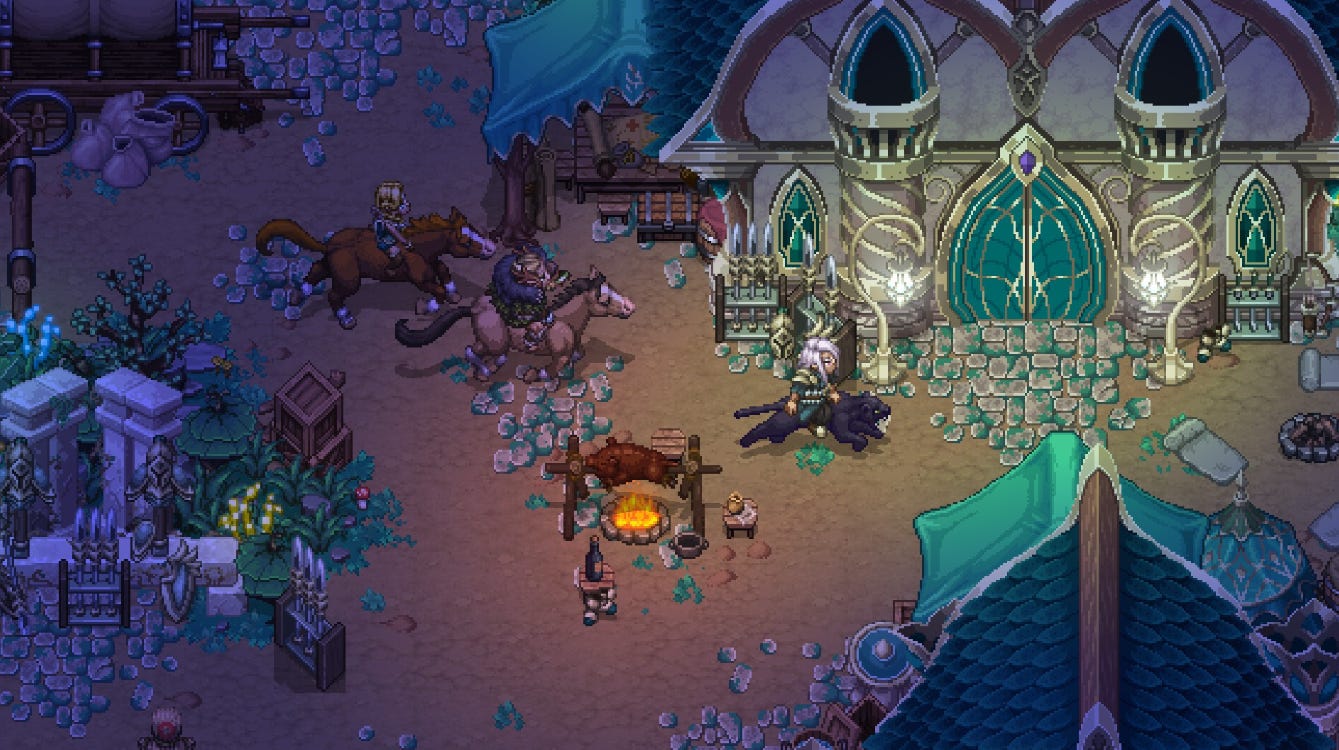
Every once in a while, a game appears that seems to fit neatly into a category for the first hour and then spends the next ten hours proving that assumption wrong.
Drakantos feels like one of those games.
At first, most MMO players immediately reach for familiar references. The pixel-art world, top-down perspective, and social MMO structure naturally remind people of classic MMORPGs. The visual language evokes memories of older online worlds where exploration, progression, and community were the center of the experience.
Then the combat starts.
Suddenly the comparison shifts. Instead of traditional click-to-target combat, Drakantos leans heavily into action gameplay, positioning, dodging, cooldown management, and mechanical execution. The game asks players to actively engage with encounters rather than simply rotate through abilities. What initially looked like a nostalgic MMO starts feeling much closer to an action RPG. Players expecting one experience often find themselves playing something entirely different.
What’s interesting is that neither expectation is completely wrong.
The challenge is that Drakantos isn’t really trying to be just one thing.
A MMO Built From Several Different Ideas
Part of the reason discussions around Drakantos have become so interesting is that different players walk away describing completely different games.
Some focus on the MMO side. They talk about progression systems, exploration, gathering, professions, world events, quests, group content, and character progression. The game includes many of the activities players expect from a modern MMORPG, alongside social systems and cooperative play. Players can progress through PvE content, engage with crafting and exploration, and participate in a growing list of activities beyond simple combat.
Others focus on the hero system.
Instead of creating a fully custom character, players choose from a roster of heroes with distinct identities, kits, and playstyles. Build customization exists through systems like Orbs, Artifacts, equipment choices, and progression paths, but the foundation remains hero-based rather than classless or fully customizable.
That single decision changes how many MMO veterans approach the game.
For players raised on Ragnarok Online, Tibia, World of Warcraft, or similar MMORPGs, character identity is often tied to creating a unique avatar and slowly shaping it over hundreds of hours. Drakantos takes a different approach, one that feels closer to hero-based multiplayer games while still maintaining long-term MMO progression.
Neither approach is inherently better.
They’re simply optimizing for different experiences.
The Combat Might Be the Biggest Surprise
Perhaps the most significant shift in Drakantos over the last year has been its willingness to rethink core systems.
Following player feedback, Wingeon moved away from its original tile-based movement system and rebuilt movement around free movement controls. Combat was also reworked into a more direct action-combat model. For a small independent studio, replacing foundational systems this late in development was a surprisingly aggressive decision.
The result is a game that feels far more action-oriented than many players initially expect.
Interestingly, this has created another divide within the community.
Some players praise the combat for emphasizing positioning, movement, resource management, and decision-making. Others feel the pace remains slower than expected for an action-focused MMO. Both reactions can be found across beta discussions, which suggests the combat is succeeding at creating a distinct identity even while players continue debating exactly what that identity should be.
This may actually be one of the most fascinating things about Drakantos right now: the community isn’t arguing about whether the game is unique.
The community is arguing about what kind of unique game it is.
More Than Just PvE
Another reason Drakantos is difficult to categorize is its surprisingly ambitious PvP vision.
Many players initially approach the game expecting a PvE-focused MMORPG. That assumption makes sense because exploration, story progression, quests, bosses, and cooperative content occupy a large part of the experience.
But PvP is not simply an afterthought.
Recent beta tests introduced multiple PvP modes, including arena-style gameplay, objective-based maps, duels, PvPvE activities, and even MOBA-inspired battlegrounds. Players can choose progression paths that emphasize PvP rather than traditional PvE content.
This creates another expectation gap.
Players arriving for a cozy MMO adventure suddenly discover competitive systems. PvP-focused players arrive expecting a battleground-driven experience and discover exploration, world progression, and cooperative activities.
The game constantly sits at the intersection of multiple audiences.
Is That a Strength or a Risk?
The most interesting question surrounding Drakantos may not be whether its systems work.
The beta has already shown that many of them do. The bigger question is whether players can accurately understand what the game is before they play it.
Gaming history is filled with examples of games that failed because they lacked identity. Drakantos feels like the opposite problem. It has several identities simultaneously.
It’s a hero-based MMO, an action RPG, a pixel-art online world, a PvE progression game, a PvP game with surprisingly ambitious competitive modes AND depending on who is describing it, any one of those elements becomes the headline. 🤯🤯
That may ultimately become one of Drakantos’ biggest strengths. Or it may continue creating mismatched expectations for players arriving from different genres.
Either way, it is one of the most interesting conversations happening around the project right now.